 Digital
 Ecommerce
 Marketing
 Search Engine
 Social Media
 Web
Web


 Hire
Hire


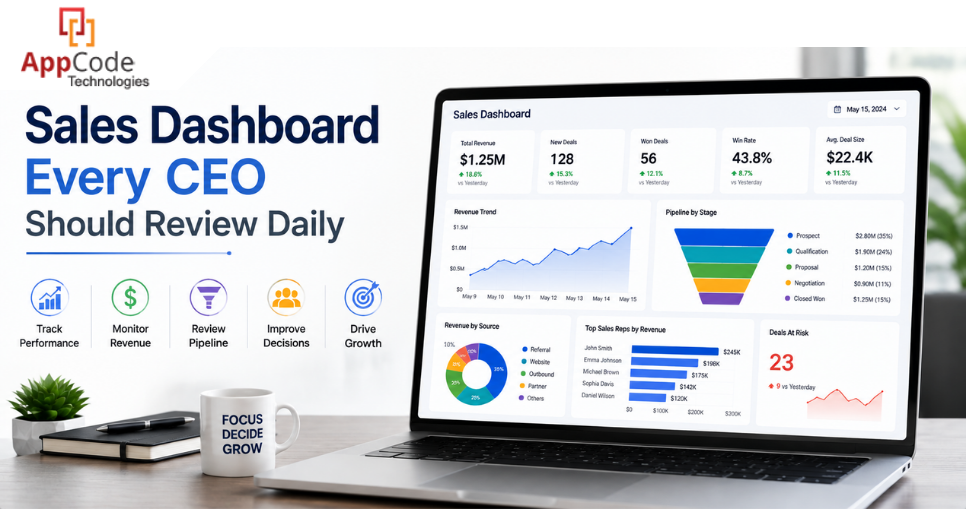
Sales Dashboard Every CEO Should Review Daily
 22 Aug 2026
 AppCode Technologies
For any growing business, sales performance is not something a CEO should review only at the end of the month. By that time, missed leads, delayed follow-ups, weak conversions, and lost opportunities may already affect revenue. A sales dashboard every CEO should review daily gives leadership a clear view of what is happening in the business right now.
A sales dashboard is not just a report. It is a decision-making tool that shows important sales numbers, lead status, team activity, campaign performance, and revenue movement in one place. For companies that want predictable growth, a daily sales dashboard helps identify problems early, improve team accountability, and make faster business decisions.
In a competitive market, CEOs need real-time visibility. They should know how many leads came in, how many were contacted, which deals are moving, which team member needs support, and which marketing channel is generating quality inquiries. Without this visibility, sales management becomes guesswork.
Why CEOs Need a Daily Sales Dashboard
A CEO does not need to check every small sales activity manually, but they should review key business indicators daily. A good sales dashboard for CEOs helps leadership understand business health without depending only on verbal updates or delayed reports.
When sales data is reviewed daily, companies can quickly identify:
- Drop in lead volume
- Delay in follow-ups
- Weak conversion rate
- Poor campaign performance
- Stuck deals
- Sales team productivity gaps
- Revenue forecast issues
- High-value leads needing attention
This allows leadership to take action before small problems become large revenue losses.
1. Total Leads Generated
The first metric in a sales dashboard should be total leads generated. This shows how many new inquiries came from all sources such as website forms, Google Ads, social media, WhatsApp, phone calls, referrals, email campaigns, and landing pages.
If lead volume suddenly drops, it may indicate a marketing issue, website issue, campaign problem, or market slowdown. Reviewing this daily helps the CEO understand whether the top of the sales funnel is healthy.
A strong sales performance dashboard should also show lead source-wise data so the business can identify which channel is bringing the most opportunities.
2. Lead Source Performance
Not all leads are equal. Some leads come from high-intent sources like Google search, while others may come from general awareness campaigns. A CEO should know which lead sources are producing better-quality inquiries.
Lead source tracking helps answer questions like:
- Which campaign is generating serious leads?
- Which platform gives low-quality inquiries?
- Which keywords are converting?
- Which channel should get more budget?
- Which marketing activity needs improvement?
This is where real-time sales analytics becomes useful. It helps leadership connect marketing spend with actual business opportunities.
3. Lead Response Time
Lead response time is one of the most important sales metrics. If a new inquiry is not contacted quickly, the customer may move to a competitor.
A CEO should review how fast the sales team responds to new leads. Even a good marketing campaign can fail if leads are not handled on time.
A daily dashboard should show:
- Average response time
- Leads not contacted
- Pending first calls
- Delayed follow-ups
- Team-wise response performance
Improving response time can directly improve conversion rate and reduce sales leakage.
4. Active Sales Pipeline
The sales pipeline shows where every lead stands in the buying journey. Without pipeline visibility, a CEO may know total revenue but not future revenue potential.
A proper sales dashboard should show pipeline stages such as:
- New lead
- Contacted
- Requirement discussed
- Proposal sent
- Follow-up pending
- Negotiation
- Closed won
- Closed lost
This helps leadership understand how many deals are moving forward and where leads are getting stuck. A strong sales pipeline dashboard makes revenue planning more accurate.
5. Follow-Up Status
Many businesses lose revenue because follow-ups are missed or delayed. Leads rarely convert after one conversation. They need reminders, nurturing, clarification, and consistent communication.
A CEO should review follow-up status daily to ensure that sales opportunities are not being ignored.
Important follow-up metrics include:
- Pending follow-ups
- Overdue follow-ups
- Follow-ups completed
- High-value leads pending action
- Leads inactive for many days
This helps improve sales discipline and team accountability.
6. Conversion Rate
Conversion rate shows how many leads are turning into customers. A business may be generating many leads, but if the conversion rate is low, revenue growth will remain weak.
A daily sales dashboard should show conversion rate by:
- Lead source
- Sales executive
- Campaign
- Service or product
- Time period
If conversion rate drops, the business may need to improve sales scripts, pricing strategy, lead quality, proposal format, or follow-up process.
7. Revenue Pipeline and Forecast
A CEO should not wait for month-end revenue reports. A daily dashboard should show expected revenue from active deals. This helps leadership plan cash flow, hiring, marketing budget, and business expansion.
Revenue pipeline metrics include:
- Total active deal value
- Expected closing amount
- Monthly target vs current pipeline
- Deals likely to close
- Delayed deals
- Lost deal value
This gives the CEO better control over business planning.
8. Sales Team Performance
A sales dashboard every CEO should review daily must include team performance. It helps identify top performers, support struggling team members, and improve accountability.
Sales team metrics may include:
- Leads handled
- Calls made
- Follow-ups completed
- Proposals sent
- Deals closed
- Conversion rate
- Revenue generated
- Pending tasks
This does not mean micromanagement. It means leadership has clear visibility and can support the team with better systems and direction.
9. Lost Lead Reasons
Lost leads are valuable because they show where the business needs improvement. If many leads are lost due to pricing, the company may need better value communication. If leads are lost due to delayed response, the process needs automation. If leads are lost due to wrong targeting, marketing campaigns need improvement.
A CEO should review lost lead reasons regularly to improve the complete sales process.
Common lost lead reasons include:
- Price issue
- No response
- Chose competitor
- Delayed follow-up
- Requirement mismatch
- Budget not available
- Weak proposal
- Low trust
This data helps create better sales and marketing strategies.
10. Campaign ROI and Marketing Contribution
Sales and marketing should not work separately. A CEO dashboard should show which marketing campaigns are supporting revenue growth.
This includes:
- Campaign-wise leads
- Cost per lead
- Lead quality
- Conversion by campaign
- Revenue from campaigns
- ROI by channel
When CEOs review this data, they can invest more in campaigns that generate quality leads and reduce spending on poor-performing channels.
Benefits of a Daily Sales Dashboard
A well-designed sales dashboard gives CEOs better control over growth.
Key benefits include:
- Faster decision-making
- Better sales visibility
- Improved follow-up discipline
- Reduced sales leakage
- Better lead conversion
- Stronger team accountability
- Accurate revenue forecasting
- Better marketing ROI
- Clear sales and marketing alignment
For growing businesses, a daily sales dashboard turns scattered information into actionable business insight.
How to Build an Effective Sales Dashboard
To build a useful sales dashboard, businesses should first define their sales goals. Then they should connect all lead sources, sales activities, follow-ups, proposals, and revenue data into one system.
The dashboard should be simple, clear, and focused on decision-making. Too many unnecessary numbers can create confusion. A CEO dashboard should show only the metrics that affect growth, sales performance, and revenue planning.
Businesses can use CRM systems, automation tools, lead management platforms, analytics dashboards, and real-time reporting systems to create this structure.
Conclusion
A sales dashboard every CEO should review daily is more than a reporting tool. It is a growth management system. It helps leadership track leads, follow-ups, pipeline, conversions, revenue forecast, team performance, and marketing ROI in real time.
Without a daily sales dashboard, businesses may miss leads, delay decisions, waste marketing budget, and lose revenue opportunities. With the right dashboard, CEOs can identify gaps early, improve team performance, and build a more predictable sales system.
AppCode Technologies helps businesses build digital growth systems through website development, SEO, digital marketing, lead generation, marketing automation, business analytics, CRM support, and real-time reporting dashboards. With the right sales dashboard, companies can improve visibility, reduce sales leakage, and grow revenue with more confidence.
FAQs
1. What is a sales dashboard?
A sales dashboard is a reporting tool that shows important sales data such as leads, follow-ups, pipeline stages, conversion rate, revenue forecast, and team performance in one place.
2. Why should CEOs review a sales dashboard daily?
CEOs should review a sales dashboard daily to identify missed leads, delayed follow-ups, weak campaigns, stuck deals, and revenue gaps before they affect business growth.
3. What should be included in a CEO sales dashboard?
A CEO sales dashboard should include total leads, lead sources, response time, active pipeline, follow-up status, conversion rate, revenue forecast, team performance, and lost lead reasons.
4. How does a sales dashboard improve revenue growth?
A sales dashboard improves revenue growth by giving real-time visibility into sales performance, helping teams respond faster, track leads better, and reduce sales leakage.
5. Can AppCode Technologies help build sales dashboards?
Yes, AppCode Technologies helps businesses build sales dashboards, lead tracking systems, marketing automation workflows, and real-time reporting solutions for better sales visibility and growth.

Why Most Companies Fail at Digital Marketing Despite Spending Lakhs

The Future of Lead Generation in the AI Era

How Marketing Automation Can Increase Qualified Leads by 3X

What Is a Martech Stack and Why Every Growing Company Needs One
How Technology Can Reduce Sales Leakage by 20-30%
Why Most Companies Fail at Digital Marketing Despite Spending Lakhs
The Future of Lead Generation in the AI Era
How Marketing Automation Can Increase Qualified Leads by 3X
What Is a Martech Stack and Why Every Growing Company Needs One
How Technology Can Reduce Sales Leakage by 20-30%
Building a Predictable Sales Engine Using CRM and Automation

Why Your Sales Team Is Working Hard But Revenue Isn't Growing
Top 10 Technology Investments Every Mid-Sized Company Should Make Before 2030

From Founder-Driven to System-Driven: The Next Stage of Growth